The country of Fungolia
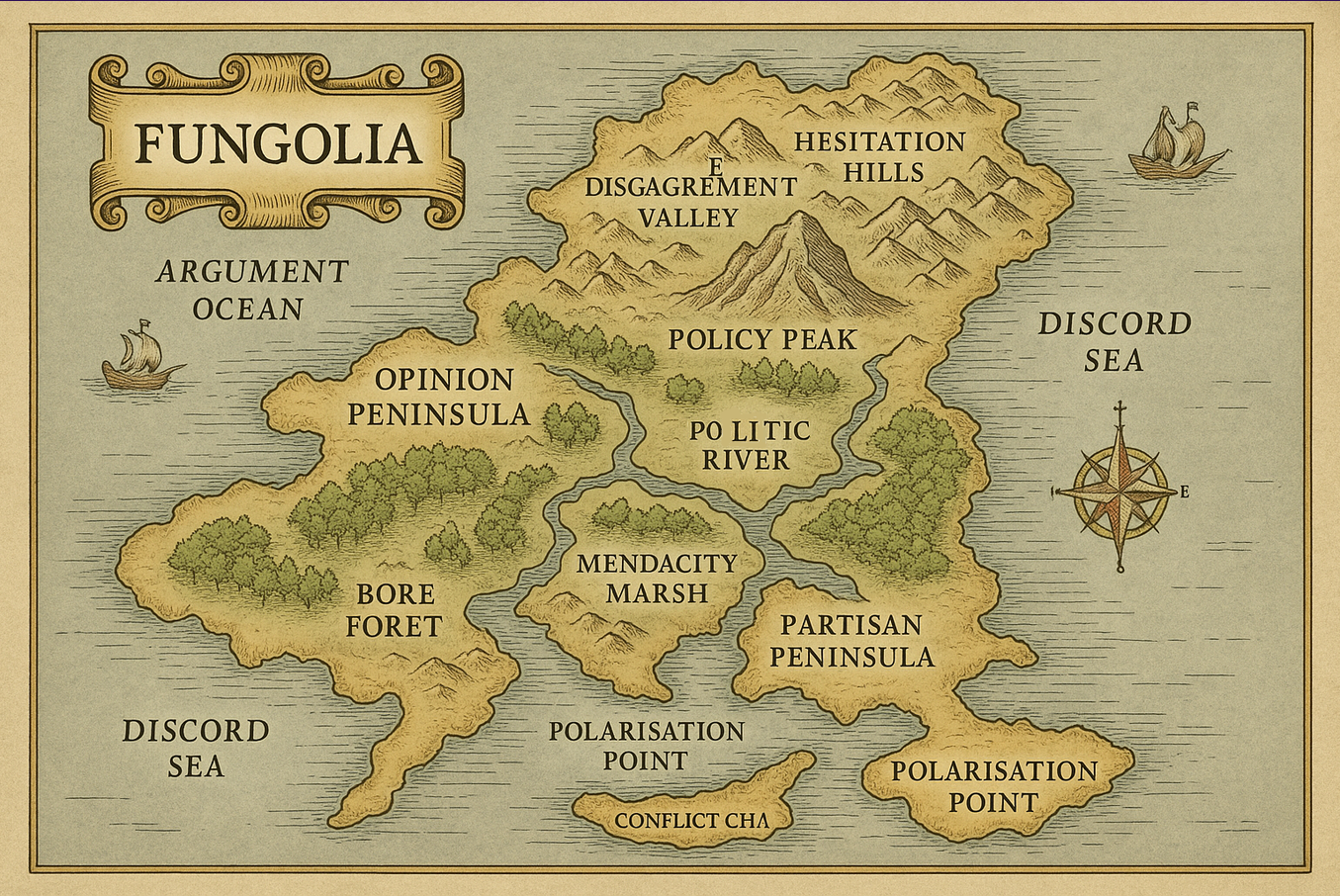
Fungolia is a small, fictional European nation best known for three things: bureaucrats with severe stationery addictions, national holidays dedicated to committee meetings, and the Mutually Suspicious Cooperation Accord, a bilateral treaty with its eastern neighbour that mostly involved not poisoning each other’s water supply. The treaty has been revised fourteen times. The water supply question remains open.
Geographically, Fungolia occupies a patch of mid-European terrain that does not appear on most maps. This is partly cartographic oversight and partly policy. The landscape runs to rolling hills and mushroom-shaped spires, with bioluminescent fungi visible on most hillsides after dark. The more significant infrastructure runs underground: government buildings extend into mycelium networks beneath the capital, data centres occupy repurposed fungal chambers, and the national ISP’s routers are, in several documented cases, mounted on tree trunks.
Governance
Fungolia operates on what its political theorists call the “passive agreement” model. Difference is not merely tolerated; it is enshrined in law, embossed in gold, and swiftly ignored in practice. The enshrining, however, is taken very seriously.
Decisions are ratified by consensus, contested by counter-consensus, and occasionally revised at an emergency committee meeting. Institutions are required to disagree formally at least once a week before any decision is finalised. This slows things down wonderfully. Decisions made under these conditions tend to stick, because everyone was heard, or at least yelled equally.
The national approach has been summarised by a senior Fungolian diplomat as follows: “Let’s all agree to disagree, publicly, in several languages, with matching stationery.” It is the closest thing Fungolia has to a foreign policy doctrine.
National philosophy
The Fungolian national outlook goes by the name “optimistic realism”: expect the worst, organise for the best, and keep the doors open even when someone is shouting through them. Especially then.
The national symbol is compost. Not marble. Compost breaks down, it stinks, and given time and care it becomes the thing everything else grows from. Fungolians apply this theory equally to civil society, interpersonal conflict, and their approach to IT infrastructure, which was assembled by enthusiastic volunteers in the early 2000s and has never quite recovered.
Entities
Four organisations share responsibility for Fungolia’s digital and communications infrastructure, in various states of productive disagreement.
The Fungolia Digital Media Authority manages spectrum allocation, IP block administration, and emergency committee scheduling. The national calendar has several slots reserved for the latter. FungusFiber Internet is the country’s sole regional LIR and primary internet provider, running a network characterised by firmware versions that suggest someone intended to update them in 2019. Security research and consultancy are handled by MycoSec Labs, headquartered in a sprawling underground facility beneath the capital. Digital rights monitoring and advocacy are the remit of OpenHands International, based in a converted subterranean library in the capital’s eastern district.
For the red team
Fungolia does not appear on most threat maps. This is largely because no one is quite sure where it is. It does, however, have a /20, several BGP peers, and enough misconfigured ACLs to keep a red team occupied for some time. Any incident response will involve at least one formal disagreement before action is taken.
The stationery will be excellent.