Normal, and when to break it
An anomaly hides best inside noise. The last piece of reconnaissance is learning a prefix’s normal, so that a later change can be judged against it, and choosing a moment when normal is already moving.
RIB or updates
The collectors offer two things, and they answer different questions. A RIB snapshot is the whole table at an
instant, for “what did this look like at 08:00”. An update dump is the stream of changes, for “what moved, and
when”. Baselining pulls a RIB for the steady state and the updates for the movement around it. An MRT dump
reads with bgpdump:
bgpdump -m bview.20260613.0800.gz | grep '|203.0.113.0/24|'
TABLE_DUMP2|1781337600|B|206.126.236.21|6939|203.0.113.0/24|6939 3356 64500|IGP|...
Across many peers, that one prefix gives its normal: the usual origin (64500), the typical path length, and
the handful of upstreams that recur. The update dumps for the same window show how often any of it changes.
What normal looks like
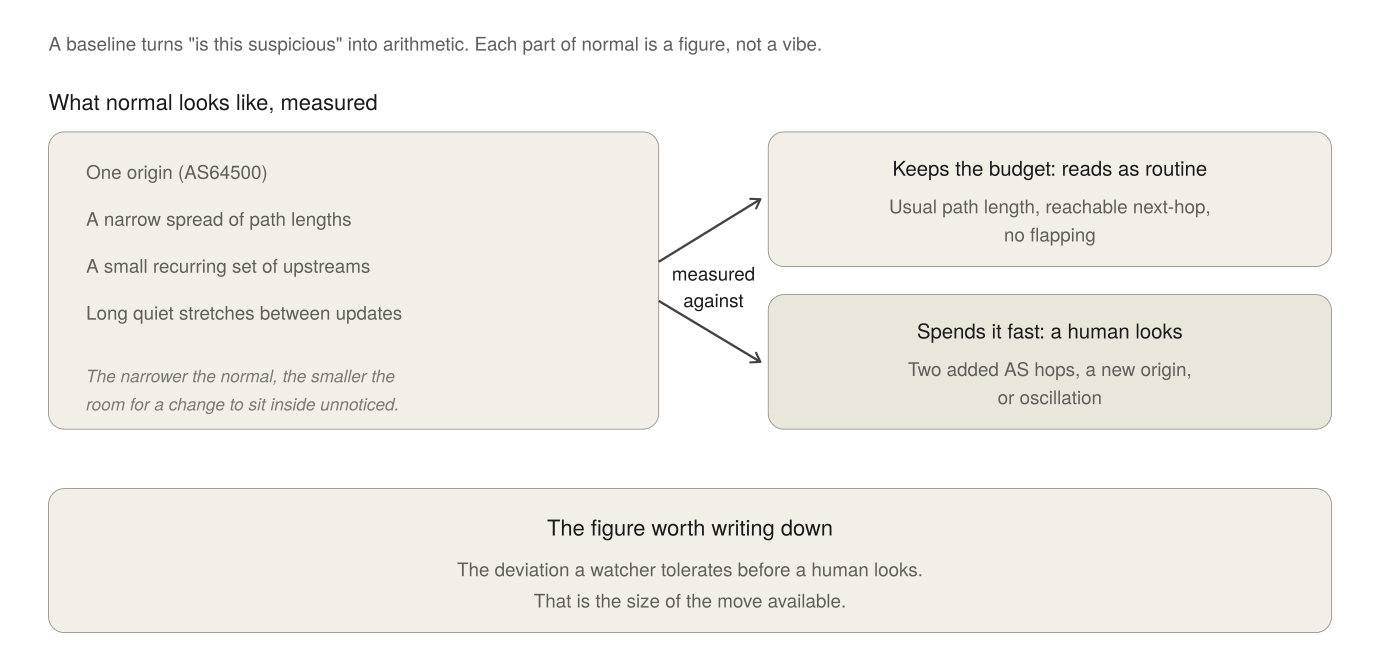
A stable prefix has one origin, a narrow spread of path lengths, a small recurring set of upstreams, and long quiet stretches between updates. Each of those is a baseline figure, not a vibe. A prefix that already flaps, or that legitimately appears behind several origins, has a wider normal and so a larger budget for a change to sit inside unnoticed. The narrower the normal, the smaller the room.
SIDN Labs’ Noisy Routers: Investigating the Make-up route collector data analysed more than 80 billion updates and found a small set of peers and prefixes generating most of the churn, a reminder that a baseline worth keeping ranks paths as stable, noisy, or anomalously noisy rather than treating every update alike.
The budget
A baseline turns “is this suspicious” into arithmetic. An announcement that keeps the prefix’s usual path length, a reachable next-hop, and avoids flapping reads as routine; one that adds two AS hops, or a new origin, or oscillates, spends the budget fast. The figure worth writing down is the deviation a watcher would tolerate before a human looks, because that is the size of the move available.
When normal is already moving
Two kinds of moment matter, for opposite reasons.
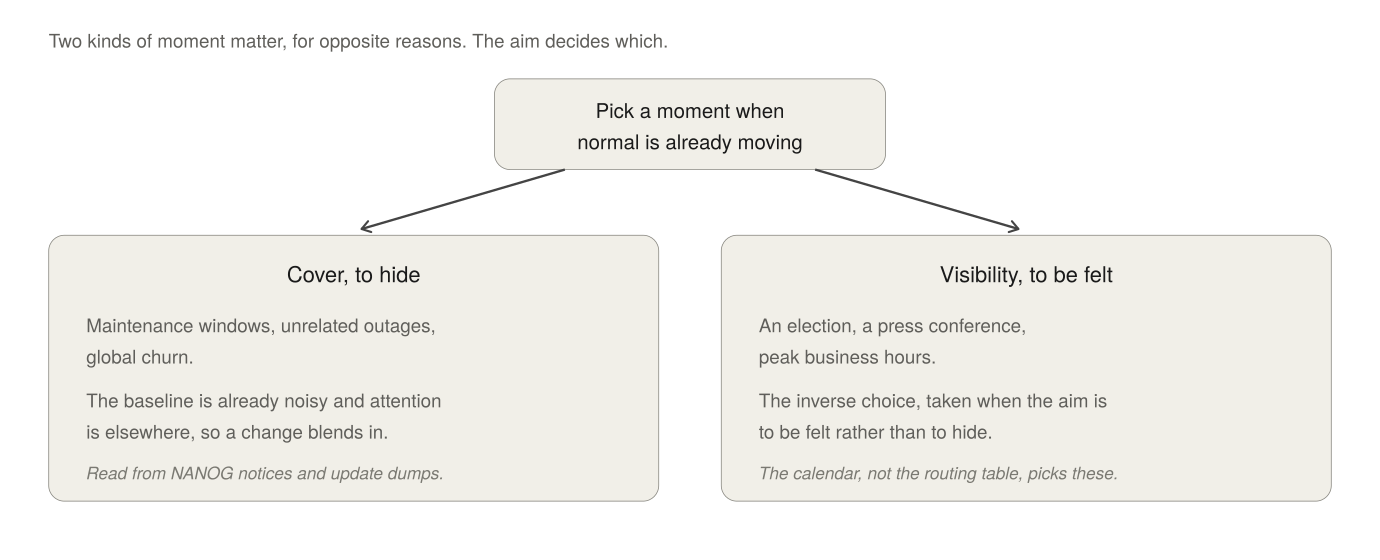
Cover: maintenance windows, unrelated outages, and global churn. Operator maintenance is often pre-announced on NANOG and regional lists, and large events leave a clear trace in the update dumps. During churn the baseline is already noisy and attention is elsewhere, so a change blends in.
Visibility: an election, a press conference, peak business hours. These are the inverse choice, taken when the aim is to be felt rather than to hide. The calendar, not the routing table, picks these.
A private listener, rather than repeated public queries, keeps the baselining itself off someone else’s logs; building one is covered under eyes/.