Surveying the defences
Inter-domain security in 2026 is unevenly deployed, and the unevenness is public. This page reads the coverage on a prefix before anything is announced: where origin validation would catch a forged route, and where it would not.
What a ROA is
The main defence is RPKI, the Resource Public Key Infrastructure. A network publishes a Route Origin Authorisation (ROA): a signed statement “this AS may originate this prefix, up to this length”. A ROA has three fields, and tools render them plainly:
ASN       Prefix            Max Length
AS64500   203.0.113.0/24    24
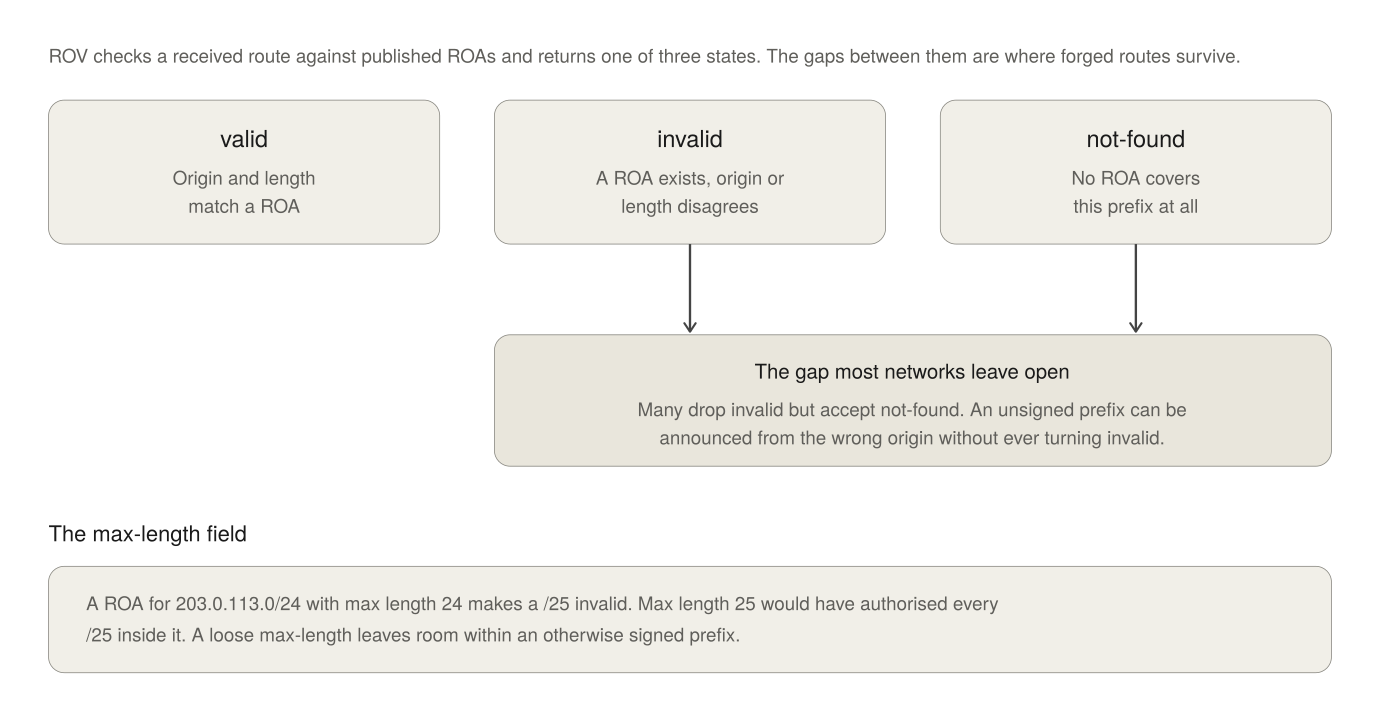
Route Origin Validation (ROV) checks a received route against the ROAs and returns one of three states:
valid       origin and length match a ROA
invalid     a ROA exists, but the origin or length disagrees
not-found   no ROA covers this prefix at all
The gap to read is between invalid and not-found. Many networks drop invalid but accept not-found, so
an unsigned prefix can be announced from the wrong origin without ever turning invalid. And a ROA for
203.0.113.0/24 with max length 24 makes a /25 invalid, whereas max length 25 would have authorised
every /25 inside it. The max-length field is where loose ROAs leave room.
Reading it without touching anything
A live validity and origin view, per prefix:
https://bgp.tools/prefix/203.0.113.0/24 # shows RPKI: Valid / Invalid / Unknown
The published ROAs themselves come from any validator’s output. Routinator and rpki-client both emit the full validated set (VRPs) as CSV, which greps cleanly:
routinator vrps --format csv | grep 203.0.113
AS64500,203.0.113.0/24,24
No ROA line for a prefix means not-found everywhere, which is the softest case.
Enforcement is separate from publication
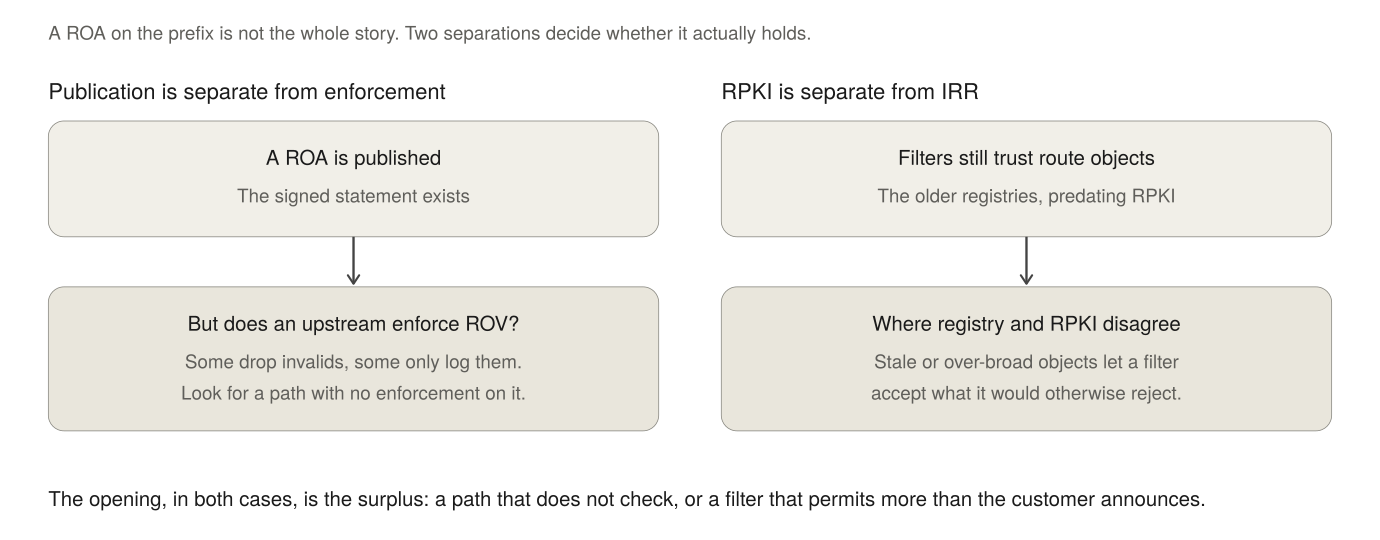
Publishing a ROA and enforcing ROV are different acts. Which upstreams actually drop invalids, and which only log them, varies by operator and region, and a single upstream that enforces validation can defeat a forged origin outright. The practical survey is a search for a path with no enforcement on it, read from the relationships and observed upstreams rather than asserted from the ROA alone.
For where this tends to break, SoK: An Introspective Analysis of RPKI Security catalogues how RPKI fails in practice, which doubles as a list of the gaps a survey is looking for.
IRR hygiene
Older than RPKI, the Internet Routing Registries hold route objects that automated prefix filters still trust. Stale or over-broad objects let a filter accept what it would otherwise reject. IRRexplorer shows where registry data and RPKI disagree, and that disagreement is exactly where ambiguity lives:
https://irrexplorer.nlnog.net/prefix/203.0.113.0/24
To see what an upstream’s filter would actually permit for a customer, generate it the way operators do, with
bgpq4:
bgpq4 -4 -l TARGET AS64500
ip prefix-list TARGET permit 203.0.113.0/24
A filter built from a loose as-set lists more than the customer actually announces, and the surplus is the
opening.